Newsletter subscription : -10% off your first order !
From 100 euros, free delivery.
Payment in 3 installments with no fees.
Watch guide: everything you need to know about watchmaking
WATCH GUIDE
Kelton opens the doors to its French workshops with this comprehensive watch guide. Founded in France in 1955, our manufacture has been mastering all calibers for seven decades, from quartz to automatic and technical diving watches.
This guide demystifies movements, maintenance, and essential choices for every enthusiast.
WATCHMAKING SECRETS REVEALED
Dedicated to enthusiasts and novices alike, this space takes you behind the scenes of Kelton watchmaking. Learn how to choose your ideal watch, understand the beating of living movements, and ensure their longevity for decades to come.
Kelton's passion for watchmaking is accessible to all: from everyday gestures to maintenance rituals, every detail counts in perpetuating French excellence.
FROM TIME MEASURING INSTRUMENT TO WRISTWATCH
Gone are the days when watches had only one function: to tell the time. Over the years, watches have become true fashion accessories that reflect individual tastes and personalities. Watchmakers have shown ingenuity and innovation in the design of timepieces. Many different styles of watches have emerged:
- pocket watches (attached to clothing by a chain)
- classic watches
- digital watches (displaying the time in numerical form, without hands)
- ultra-thin watches
- sports watches (featuring complications such as GPS, heart rate monitors, music players, etc.)
- modern watch (watch with a contemporary design that stands out from classic watches)
- chronograph watch (includes an additional function called a complication, which is similar to a stopwatch)
- vintage watch (antique watch or modern watch combining vintage aesthetics and modernity)
- skeleton watch (watch with a refined design revealing the components of the watch)
- aviator watch (the dial generally reflects the world of aviation and cockpits)
- military watch
- diving watch
- sports watch
- connected watch or smartwatch
THE DIFFERENT PARTS OF A WATCH
MOVEMENTS
Types of movements:
- Mechanical watches run on kinetic energy (and therefore do not require batteries). They can be manually wound or self-winding:
- Manual: the watch is wound every day using the crown. The crown must be turned clockwise between 30 and 40 times. This winds the spring, which then unwinds to drive the mechanism.
- Automatic: the watch is wound by the movements of the wrist, which turn the rotor (or oscillating metal weight) and wind the barrel spring. The energy is transferred to the various components of the watch: balance wheel, anchor, escape wheel.
- Quartz watch: this type of watch runs on electrical energy supplied by a battery. The quartz crystal undergoes more than 32,000 vibrations per second. These watches are more accurate than mechanical watches, losing only one second in six years.
- Solar quartz watch: this type of watch runs on solar energy supplied by a rechargeable battery. A tiny solar panel on the watch face converts light into electrical energy.
WATCH COMPOSITION
Types of watch cases:
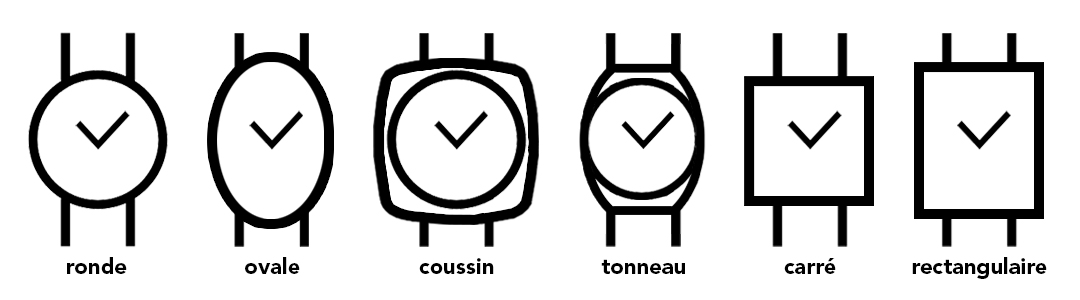
There are five main types of cases: round, square, rectangular, oval, cushion, and barrel.
GLASSES
- Acrylic glass (or Plexiglas) is often used on entry-level watches.
- Mineral glass has been used in watchmaking for years. It is the glass par excellence.
- Sapphire glass is used on high-end watches. It is the most resistant, but also the most expensive.
BRACELETS
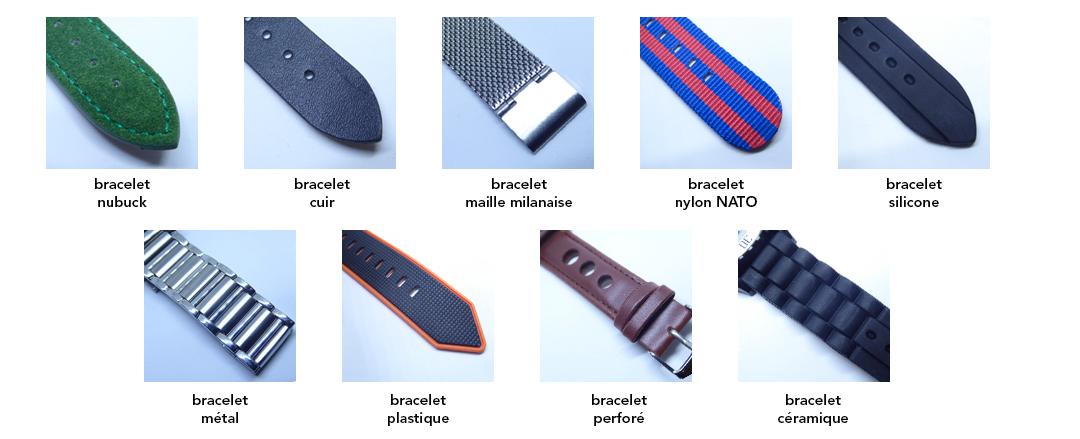
- nubuck bracelet
- leather bracelet
- Milanese mesh bracelet
- nylon bracelet (NATO)
- silicone bracelet
- metal bracelet
- plastic bracelet
- perforated bracelet
- ceramic bracelet
CLASPS
- clip clasp
- sliding clasp
- single folding clasp (one hinge) or butterfly clasp (two hinges)
- folding clasp with safety catch
- folding clasp
- pin buckle clasp
- Velcro clasp

DISPLAY
- analog consisting of 3 hands (hours, minutes, and seconds) or 2 hands (hours and minutes).
- digital consisting mainly of LEDs and liquid crystals.
- digital consisting of LEDs and liquid crystals displaying the time in digits only.
- Binary display consisting of LEDs displaying a binary code for reading the time without hands or digits.
DIALS
- Window dials consisting of several openings to indicate the time.
- Time zone dials consisting of several displays showing different time zones.
- Diving dials consisting of a dive time indicator.
- Calendar dials displaying the day, date, and year.
WATCH WATER RESISTANCE
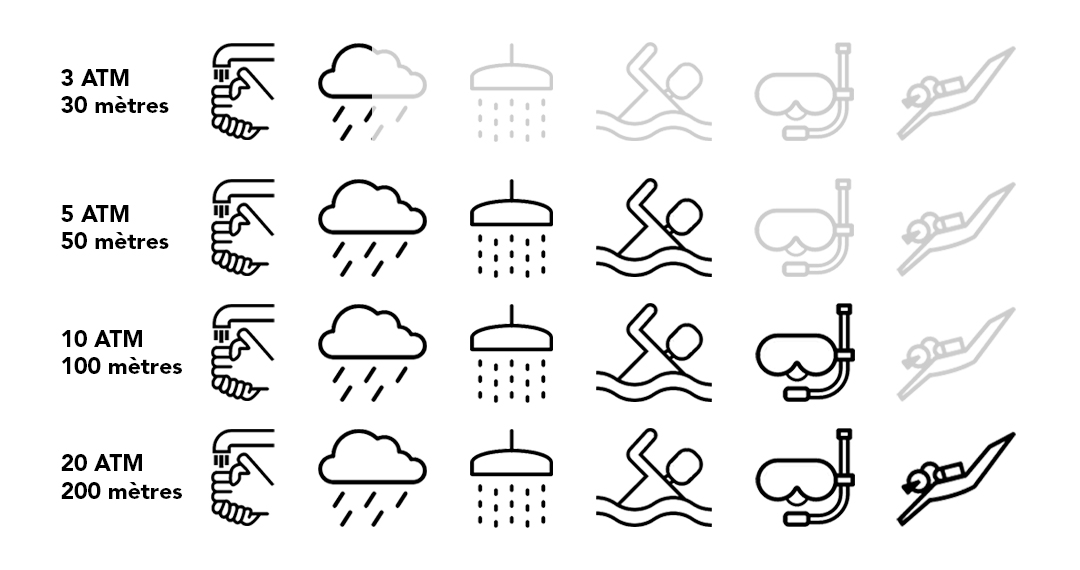
Atmosphere (or ATM) is the unit of measurement for pressure. It indicates the water resistance of a watch.
- 3 ATM: resistant to moisture and splashes, but not immersion.
- 5 ATM: withstands immersion during bathing and swimming without diving.
- 10 ATM: withstands immersion in shallow water. No problem for water sports such as surfing, swimming, etc.
- 20 ATM: withstands deep water immersion such as scuba diving.

2 years warranty

Free 48-hour delivery
on orders over €100

Designed and assembled
in France

Secure payment
in 3 installments at no extra cost